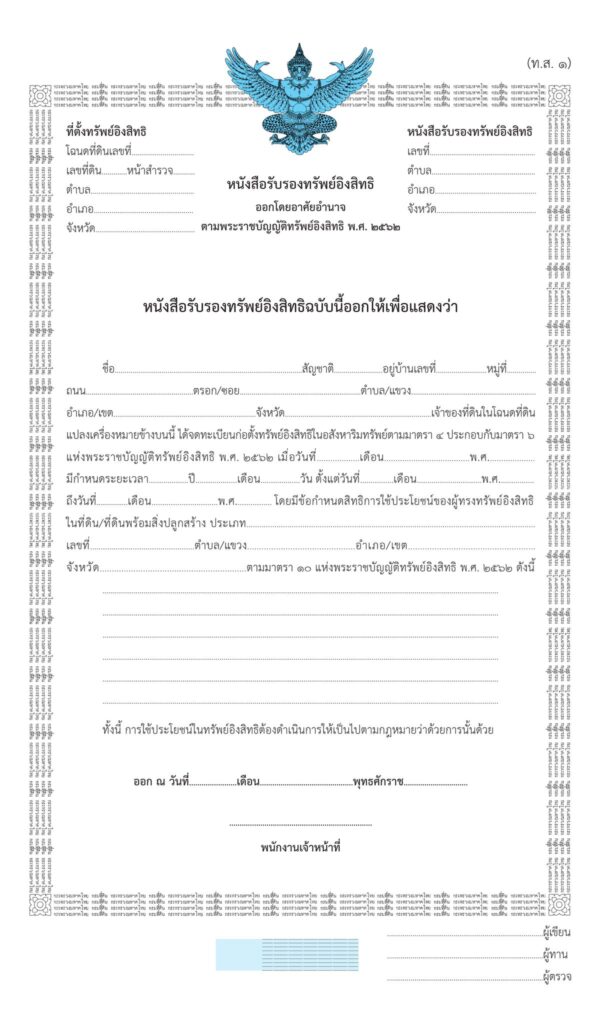

To consider as a foreign buyer. ROLA versus standard leasehold.
For foreign investors looking at Thai real estate, ownership laws have traditionally presented significant challenges.
Strict restrictions on land ownership have led to less secure and several illegal workarounds.

However, a valid legal alternative is available: the Right Over Leasehold Asset (ROLA). Also called a Sap-Eng-Seth right in Thai, this right was developed some years ago and, although seldom used it has distinct advantages.
ROLA can be seen as a substitute title document. It is a government-issued certificate, formally known as a Right Over Leasehold Asset Certificate, that grants the holder a comprehensive set of rights over a property. It is visually distinct, bearing a blue Garuda emblem, compared to the red emblem on a standard Thai title deed.
This certificate functions nearly identically to a traditional title deed for practical purposes. It can be used to apply for construction permits, serve as collateral for bank loans, facilitate buying and selling transactions, and be formally transferred. Critically, it can also be inherited by the holder’s heirs.
When a ROLA is established, the underlying Thai title deed (for the land or condominium unit) is effectively frozen for the duration of the right. No further legal claims or encumbrances can be placed on it without the consent of the ROLA holder.
A ROLA can be established over three types of immovable property:
1. Land with a formal title deed.
2. Land with a structure built on titled land.
3. A condominium unit held under a strata title.

Superior Security Compared to a Standard 30-Year Lease
While long-term leases have been a common route for foreigners, the ROLA offers greater security and utility.
First, the holder receives a tangible, state-issued certificate of their right, akin to a title deed. A standard lease offers no such document.
Second, the ROLA is a transferable asset in itself, not merely a personal contract. This enhances its liquidity and market value.
Third, its function as loan collateral provides the holder with access to financing, an option typically unavailable with a lease contract.
Fourth, the right of inheritance ensures legacy planning and permanence that standard leases do not automatically provide.
Fifth, the holder has the independent right to utilize the property for official purposes, such as obtaining building permits or utility meters, without needing permission from the original property owner
Finally, once established, the property owner cannot place any new proprietary interests on the asset without the written consent of the ROLA holder, providing a powerful layer of protection.